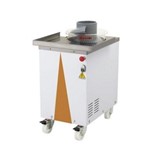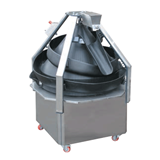


Key takeaways
- Price range: Dough dividers cost $2,500-$35,000+; dough sheeters cost $1,000-$25,000+ in Australia (2026 new pricing).
- Core difference: Dividers portion bulk dough into uniform pieces by weight or volume. Sheeters roll dough to a uniform thickness for lamination, pastry sheets or pizza bases. They solve different production steps.
- If your production bottleneck is portioning bulk dough into consistent-weight pieces: specify a divider. If your bottleneck is rolling dough to a consistent thickness for pastry, croissant or pizza production: specify a sheeter.
- Many bakeries need both: the divider portions the bulk dough first, then the sheeter rolls individual pieces to the required thickness. They are sequential, not interchangeable.
- Running costs are comparable: both categories cost $300-$1,500/year in maintenance. Sheeters add roller and belt replacement ($200-$800/set); dividers add blade and seal replacement ($100-$500/set).
- Compliance: both require food-grade contact surfaces under FSANZ requirements and machine guarding compliant with AS/NZS 4674.
Dough divider vs dough sheeter Australia (2026): Which bakery machine do you need for portioning, rolling or both?
Dough dividers and dough sheeters are both standard production equipment in Australian commercial bakeries, but they handle different steps in the dough processing workflow. Confusing one for the other - or buying only one when you need both - creates a production gap that either wastes labour or compromises product consistency. At $2,500-$35,000 for a divider and $1,000-$25,000 for a sheeter, the combined investment is significant, and getting the specification right for each machine avoids doubling up on cost or capability.
This guide compares both machine types across function, cost and production fit. To compare pricing, get quotes for dough dividers or get quotes for dough sheeters on HospitalityHub.
Bakeries where this comparison drives the equipment purchase:
- Retail bakeries producing bread, rolls and pastry products across the same production line
- Pizzerias needing both portioned dough balls and rolled pizza bases
- Pastry operations producing croissants, danishes and puff pastry requiring lamination
- In-store bakeries (supermarkets, cafes) evaluating which machine to purchase first
Identify your production step
Before costing anything, confirm which production bottleneck you are solving. Your answer determines the machine type - or whether you need both.
Factor | Dough Divider | Dough Sheeter |
|---|---|---|
Primary function | Portions bulk dough into uniform-weight pieces | Rolls dough to a uniform thickness |
Production step | After mixing, before proofing/shaping | After portioning, before cutting/laminating/shaping |
Output | Individual dough pieces of consistent weight | Flat dough sheets of consistent thickness |
Key products served | Bread rolls, buns, pizza dough balls, scones | Croissants, danishes, puff pastry, pizza bases, pie tops |
Throughput | 60-3,000+ pieces/hour | Continuous rolling - limited by dough feed rate |
Price range (new) | $2,500-$35,000+ | $1,000-$25,000+ |
If your production line requires uniform-weight pieces from a bulk batch, specify a divider. If it requires uniform-thickness sheets from individual pieces, specify a sheeter. If your product range includes both bread rolls and laminated pastries, you need both machines operating in sequence.
Dough dividers sit immediately after the mixer in the production sequence. A 15 kg mixer batch goes into the divider hopper and comes out as 20-36 uniform pieces ready for rounding, proofing and baking. Without a divider, this step is done by hand-scaling - the slowest and least accurate step in bakery production.
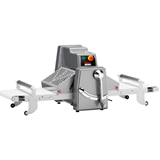
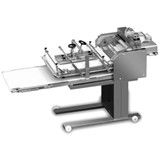
Dough sheeters sit after portioning and initial rounding. Individual dough pieces pass through the rollers and come out as flat sheets at a controlled thickness (typically 1-20 mm adjustable). Croissant and danish production requires multiple passes through a sheeter with butter lamination between passes - a process that cannot be replicated by hand at commercial speed or consistency.
Evaluate the key specifications
With your machine type confirmed, these are the specs that separate models within each category.
Specification | Dough Divider | Dough Sheeter |
|---|---|---|
Critical spec | Portioning accuracy (+/-1-5%) | Minimum/maximum thickness range (1-20 mm) |
Capacity | Hopper: 6-50 kg per load | Belt width: 400-650 mm (bench) / 600-800 mm (floor) |
Power | 0.5-3 kW (single or three-phase) | 0.37-1.5 kW (mostly single-phase for bench models) |
Footprint | 600 x 600 mm to 900 x 1,200 mm | Bench: 500 x 900 mm / Floor: 700 x 2,000 mm |
Key wear part | Cutting grid/blade and hydraulic seals | Rollers, conveyor belt, scraper blades |
The most common mistake is buying a sheeter expecting it to portion dough. Sheeters roll to thickness - they do not divide by weight. A bakery that needs 40 g dinner rolls still needs a divider or manual scaling before the sheeter stage. The consequence is either wasted labour on hand-scaling or inconsistent piece weights across the production run.
Understand the full cost breakdown (2026 prices)
Both machine types are relatively low-cost bakery capital items with fast payback through labour displacement.
Category | Dough Divider (AUD) | Dough Sheeter (AUD) |
|---|---|---|
Entry-level new | $2,500-$8,000 (manual hydraulic) | $1,000-$3,000 (manual benchtop) |
Mid-range new | $8,000-$20,000 (semi-auto divider-rounder) | $3,000-$10,000 (electric bench or floor model) |
High-spec new | $20,000-$35,000+ (fully automatic volumetric) | $10,000-$25,000+ (auto reversible floor model) |
Used / refurbished | $1,500-$15,000 | $500-$8,000 |
Annual maintenance | $300-$1,500 (seals, blades, service) | $300-$1,200 (belts, rollers, scrapers) |
A bakery producing 500+ pieces/shift that currently hand-scales and hand-rolls saves $25,000-$40,000/year in labour by adding both machines. A mid-range divider at $12,000 plus a mid-range sheeter at $6,000 pays back within 6-8 months at that volume. Get quotes for dough dividers to compare current pricing against your production requirement.
Decision framework - dough divider vs dough sheeter
Decision Factor | Choose Dough Divider | Choose Dough Sheeter |
|---|---|---|
Production bottleneck | Hand-scaling is the slowest step | Hand-rolling is the slowest step |
Primary product | Bread rolls, buns, scones, pizza dough balls | Croissants, danishes, puff pastry, pizza bases |
Quality driver | Consistent piece weight across the batch | Consistent thickness for even baking and lamination |
Space constraint | Compact floor models available (600 x 600 mm) | Benchtop models fit small kitchens (500 x 900 mm) |
Budget under $5,000 | Manual hydraulic divider ($2,500-$5,000) | Manual or electric benchtop sheeter ($1,000-$3,000) |
Both tasks needed | Buy both: divider first in the workflow, sheeter second | Buy both: divider first in the workflow, sheeter second |
Evaluate suppliers
You are ready to go to market. Use this checklist to compare both machine types from the same or different suppliers.
Factor | What to Ask |
|---|---|
Both types stocked | Does the supplier carry both dividers and sheeters for a single-source purchase? |
Dough demo | Can you trial both machines with your actual dough before purchasing? |
Bundle pricing | Is a discount available for purchasing divider + sheeter + rounder together? |
Power requirements | Single-phase or three-phase for each machine? Does your bakery have the supply? |
Cleaning access | Can food-contact surfaces be fully disassembled for cleaning on both machines? |
Warranty | What is the full warranty period for each machine? |
Spare parts | Are blades, seals, belts and rollers held in Australian stock? |
FSANZ compliance | Are all food-contact surfaces verified food-grade stainless steel? |
AS/NZS 4674 | Does the machine guarding comply with food processing machinery safety standards? |
Frequently asked questions
Can a dough sheeter replace a dough divider?
No. Sheeters roll dough to a uniform thickness - they do not divide by weight. A bakery producing uniform-weight pieces still needs a divider or manual scaling before the sheeting step.
Which machine should a new bakery purchase first?
If your primary product is bread, rolls or buns, purchase the divider first - it eliminates the biggest labour bottleneck. If your primary product is laminated pastry (croissants, danishes), purchase the sheeter first.
How much does it cost to buy both a mid-range divider and sheeter?
$14,000-$30,000 combined for a semi-automatic divider-rounder at $8,000-$20,000 plus an electric floor sheeter at $3,000-$10,000. Both qualify for instant asset write-off if each unit is under $20,000.
What is the labour payback when purchasing both machines together?
A bakery producing 500+ pieces/shift saves $25,000-$40,000/year in portioning and rolling labour. An $18,000 combined purchase pays back within 6-8 months at that volume.
Do both machines require three-phase power?
Semi-automatic and automatic dividers typically require three-phase. Most benchtop and smaller floor sheeters run on single-phase. Check your bakery's electrical supply before purchasing.
What matters most
- They solve different production steps: dividers portion by weight; sheeters roll to thickness
- Not interchangeable: a sheeter cannot replace a divider for portioning, and vice versa
- Many bakeries need both: divider first in the workflow, sheeter second
- Combined payback is fast: 6-8 months at 500+ pieces/shift
- Trial with your dough before purchasing: portioning accuracy and rolling consistency vary between brands
Most buyers shortlist 2-3 models of each machine type after getting comparative quotes.
Don't waste time contacting suppliers individually. HospitalityHub gives you direct access to verified Australian bakery equipment suppliers - where hospitality buyers request and compare multiple quotes so they can buy with confidence.
- Get quotes for dough dividers - contact multiple verified suppliers with a single enquiry
- Compare models - filter by capacity, configuration and region
- Contact suppliers directly - speak to specialists who service your state
? Get and compare dough divider quotes now ?